TAKE ACTION NOW
DON'T WAIT ANY LONGER
When critical decisions meet reality, they either hold — or their weight compounds
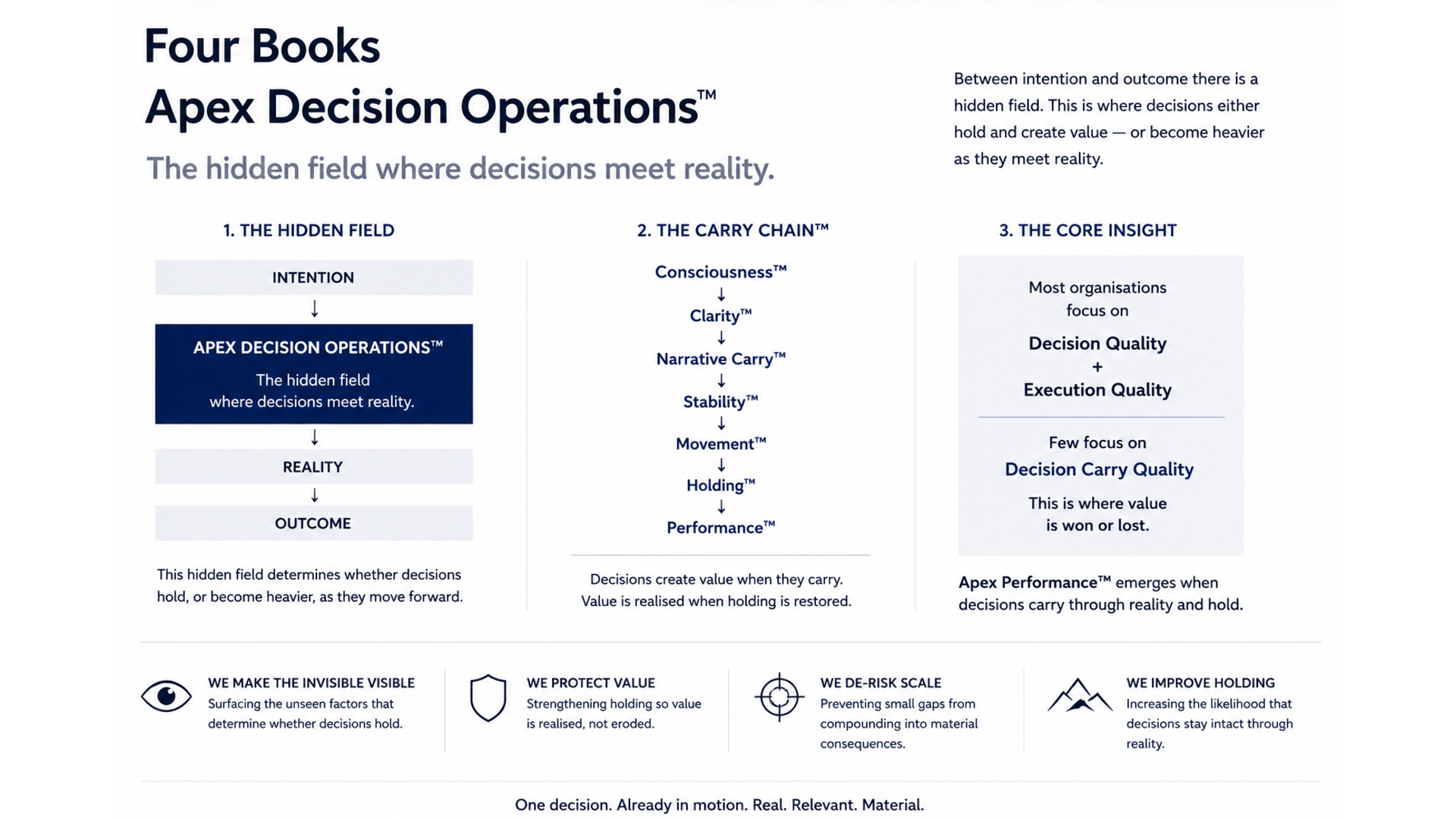
Four Books specialises in Apex Decision Operations™ and Apex Decision Operations™ Management: the hidden Apex field where critical decisions move from intent into real organisational conditions — and either hold, carry, weaken, fragment, or compound weight.
This is not decision-making, execution, governance, process, people, or systems.
It sits within and between them.
As organisations scale, this field is often felt first as weight: more coordination, more interpretation, more correction, more leadership energy, more delay, more friction.
That weight is often accepted as inevitable.
It is not always inevitable.
Four Books makes visible whether one critical decision already in motion still holds, where it weakens, how much, and why — before more capital, coordination, time, systems, AI, automation, or execution velocity are committed.
One decision. In-flight. Non-disruptive. Measured. Reversible.
Critical decisions do not stay where they are made
They travel.
They move through leadership, finance, product, operations, people, culture, customers, data, systems, planning, ERP, CRM, AI, automation, and time.
As they move, their meaning can stay intact — or begin to shift.
Their assumptions can remain coherent — or become interpreted differently.
Their accountability can remain explicit — or become distributed and blurred.
Their consequences can remain visible — or become hidden in coordination, delay, rework, exceptions, and management effort.
This is where Four Books works.
Not at the level of whether the decision was good or bad.
But in the operating reality of whether the decision still holds as it moves.
Apex Decision Operations™ is the hidden field
Apex Decision Operations™ is the hidden Apex field where critical decisions meet reality and either hold, carry, weaken, or compound weight.
It is usually not managed explicitly.
It is hidden because the decision may already look strong:
The strategy may be clear.
The business case may be approved.
The leadership team may be capable.
Governance may be in place.
Execution may be active.
Systems may be improving.
Data may be increasingly visible.
And still, the decision can begin to feel heavier than expected.
That is often where Apex Decision Operations™ first becomes visible.
Not as a single failure.
Not as a broken function.
Not as an obvious error.
But as weight around a decision that no longer fully holds or carries as expected under real conditions.
The weight is often felt before it is seen
In scaling organisations, more meetings may be needed to keep the decision aligned.
More interpretation may be needed to explain what was meant.
More coordination may be needed to make things move.
More exceptions may appear than expected.
More leadership energy may be spent keeping the decision alive.
Because the organisation is growing, this weight is often accepted as the natural cost of scale.
Sometimes it is.
But not always.
Sometimes the weight is a signal that the decision is no longer holding cleanly across the conditions it now faces.
The decision may still be directionally right.
The ambition may still be sound.
The team may still be strong.
Execution may still be moving.
But the decision-in-reality may have weakened.
Four Books makes that visible.
The Pattern
| What appears to be true | What may be happening underneath |
|---|---|
| The strategy is clear | The decision is carrying more than expected |
| Execution is in motion | More interpretation is needed to make it work |
| Systems are improving | Alignment load is increasing |
| People are capable | Coordination cost is rising |
| The business is growing | Reversibility may be declining |
| Nothing is visibly broken | The decision may not fully hold under real conditions |
When decisions do not fully hold, consequence compounds
The cost of a non-holding decision rarely stays isolated.
It can compound across:
Capital — more capital may be committed before the decision’s real holding quality is visible.
Coordination — more organisational energy is spent aligning, correcting, interpreting, escalating, and compensating.
Time — reversibility declines as the decision becomes embedded in commitments, systems, dependencies, hiring, customers, partners, and expectations.
Increasingly, this also compounds through the systems that scale execution:
AI. Automation. ERP. CRM. Connected planning. Forecasting. Autonomy applications. Human-machine workflows.
If the decision holds, those systems can help scale coherence.
If the decision does not hold, they may scale the weight.
That is why Apex Decision Operations™ has strategic magnitude.
Apex Decision Operations ™ must be consciously managed
Because Apex Decision Operations ™ is hidden, it is easy to make magnitude mistakes.
A company may add more governance when the issue is decision holding.
More reporting when the issue is interpretation.
More execution pressure when the issue is fragmented accountability.
More systems when the decision itself has not stabilised in reality.
More AI or automation when what is being accelerated does not yet fully hold.
Apex Decision Operations ™ Management does not mean adding more process, control, or organisational machinery.
It means making the decision-in-reality visible enough to:
see where it still holds,
see where it weakens,
understand how much,
understand why,
clarify who must carry what,
stabilise only what must be stabilised,
preserve movement,
reduce unnecessary weight,
and avoid scaling what does not yet hold.
Less, not more.
Precision, not programme.
Stabilisation, not transformation.
What Four books works on
| What it is | What it is not |
|---|---|
| The operating reality of whether a critical decision still holds | Decision-making |
| A hidden Apex field within and between functions | Execution consulting |
| A way to see where decision weight is coming from | Governance redesign |
| A contained examination of one real decision in motion | Transformation programme |
| A basis for stabilising only what must be stabilised | Broad organisational review |
| A way to improve carry before more scale is added | Systems implementation |
Four Books starts with one decision
Four Books does not begin with a system, scheme, framework, transformation, maturity model, or broad organisational review.
We start with one critical decision already in motion.
Because one decision is enough to reveal where the hidden field is working — and where it is not.
A single decision can show:
where intent remains coherent,
where assumptions no longer travel cleanly,
where accountability becomes unclear,
where capital exposure is increasing,
where coordination load is rising,
where time is reducing reversibility,
where systems may scale coherence,
and where systems may scale weight.
If the decision holds, that becomes visible.
If part of it weakens, that part can be stabilised.
If a broader pattern appears, only then should the broader pattern be examined.
This is why the work remains contained.
What Four Books makes visible
When a decision starts to feel heavier than expected, it can be hard to see why. The strategy may still make sense.
The people may be capable.
The work may already be moving.
The systems may be improving.
And still, something takes more effort than it should.
Four Books helps make that visible.
Not to judge the decision.
But to see what is actually happening around it.
One decision is enough to see complex reality
Complex reality does not need to be examined everywhere at once.
It can often be seen clearly through one real decision already in motion.
That is why Four Books starts there.
One decision can show where things still hold, where they feel heavier, and what may need to be stabilised.
Often, that is enough.
The decision becomes clearer.
The weight becomes visible.
What must be stabilised becomes specific.
The decision can hold better.
And the work can stop there.
No broader programme is needed
Sometimes one decision opens a bridge
Sometimes, one decision shows something more.
It may reveal that the same weight appears in two or three related decision areas.
Or that one part of the organisation is carrying more than expected.
Or that the same pattern appears across capital, coordination, time, systems, teams, ownership, or execution.
That does not mean everything must be reviewed. It means leadership can now see whether the issue is contained — or whether a deeper structural pattern may need careful attention.
The starting point remains the same:
one decision first.
Still contained. Still reversible.
Even if a wider pattern appears, Four Books does not turn the work into a system, framework, rollout, or transformation.
The work remains designed to protect the CEO, CFO, and leadership team from unnecessary organisational weight.
| Principle | What it means | Value for the CEO/CFO |
| In-flight | The work starts with a real decision already moving through the organisation | Reality is examined where consequence is already forming |
| Contained | The scope starts with one decision structure and only expands if the pattern justifies it | The work does not become a broad consulting programme |
| Measured | The focus is on what becomes clearer, what holds, what weakens, and what must be stabilised | Leadership gets usable visibility, not abstract diagnosis |
| Reversible | Each step has a clean exit and does not force the next step | The client keeps control; no dependency is created |
| Safe | The work does not judge the decision, the team, or the leadership model | The CEO/CFO can examine reality without creating defensiveness |
| Light | The intervention adds as little process, noise, and organisational burden as possible | Four Books reduces weight rather than adding to it |
The principle is simple:
the work should not become heavier than the decision it helps clarify.
If deeper structural analysis is needed, it begins from what the one decision has already made visible.
One decision structure first.
One organisational structure if needed.
Only then, and only if the pattern justifies it.
This keeps the work close to reality — and prevents unnecessary weight.
From felt weight to visible clarity
| What leaders may feel | What Four Books helps make visible |
|---|---|
| “This is taking more effort than expected.” | Where the decision is carrying too much weight |
| “We are spending more time aligning.” | Where meaning, priorities, or ownership are not clear enough |
| “People understand it differently.” | Where the decision is being interpreted in different ways |
| “More correction is needed.” | Where the decision is not moving cleanly through the organisation |
| “This is becoming harder to reverse.” | Where commitments are reducing flexibility |
| “We are about to scale this further.” | Whether the decision is ready to carry more |
| “Something feels heavier, but nothing is clearly broken.” | Where the decision may not fully hold under real conditions |
| “This may not only be about this decision.” | Whether a wider pattern is appearing across other decisions or parts of the organisation |
This is the first value of Four Books: making visible what was previously only felt. Once that is visible, leadership can see whether: the decision already holds,
one part needs stabilising,
the decision can carry more,
the work can stop there,
or a wider pattern should be examined carefully. The work starts small. It can end small. And if it needs to go deeper, it does so from reality — not from a framework.
What Four Books Makes Visible
| Question | What Four Books clarifies |
|---|---|
| Where does the decision hold? | What is strong, stable, and can continue |
| Where does it weaken? | Where interpretation, coordination, correction, or risk is increasing |
| How much does it weaken? | Whether the weakness is minor, material, or structural |
| Why does it weaken? | Which assumptions, dependencies, ownership gaps, or execution realities explain it |
| Who must carry what? | Where accountability must become explicit |
| What must be stabilised? | What should be adjusted before more scale is added |
| What should not yet scale further? | Where unresolved weakness may compound |
Founder-led by Michael Janus Jensen
Four Books is founder-led by Michael Janus Jensen.
Michael brings more than three decades of experience across enterprise technology, connected planning, SaaS scale, IPO and PE environments, finance, commercial execution, and executive decision reality.
His background also includes computer science, operating systems thinking, interpreters, compilers, and systems logic.
That combination matters because Apex Decision Operations is not a single functional issue.
It sits within and between strategy, finance, systems, execution, people, language, culture, and time.
Four Books exists because this hidden field is increasingly consequential — especially as organisations scale further through people, capital, systems, AI, automation, and connected execution.
Begin with one decision
The first step does not need to be large.
It can begin with one decision already in motion.
A decision where the strategy may still be sound.
The team may still be capable.
Execution may still be active.
Systems may still be improving.
But the weight has changed. Four Books makes visible whether that weight is inevitable — or whether the decision can hold and carry better.
Begin with one decision.